Caffeine · 6 min read
Matcha vs coffee: which has more caffeine?
Matcha has more caffeine per gram. Coffee usually has more per cup. The difference comes down to how much of each you use.
By the Romeé teamUpdated 4 sources
On this page
The quick version
- A 12-ounce brewed coffee has 113 to 247 mg of caffeine, according to the FDA.
- Published analyses put matcha powder at 18.9 to 44.4 mg of caffeine per gram, more than coffee beans per gram. Two grams of matcha works out to roughly 38 to 89 mg.
- Matcha is shade-grown and ground from the whole leaf. Per gram, it carries more caffeine than other green teas.
- The idea that matcha energy feels calmer rests on L-theanine research. It hasn’t been tested head-to-head against coffee.
The short answer
A cup of coffee usually has more caffeine than a serving of matcha. The FDA puts a 12-ounce brewed coffee at 113 to 247 mg.[1] Matcha depends on the grade and how much powder you use. At the levels reported in the research, 2 grams of matcha holds roughly 38 to 89 mg.[2]
Per gram, though, matcha has more caffeine. The difference is how much of each you use.
Per gram vs per cup
A 2020 review of matcha research compiled these caffeine levels:[2]
| Material | Caffeine per gram |
|---|---|
| Matcha powder | 18.9 to 44.4 mg |
| Other green teas | 11.3 to 24.67 mg |
| Coffee beans | 10 to 12 mg |
So matcha packs more caffeine per gram than coffee beans. But a 12-ounce coffee is brewed from many more grams of beans than a serving of matcha uses in powder, which is why the cup of coffee usually comes out ahead.
| Drink | Caffeine | Source |
|---|---|---|
| Brewed coffee, 12 oz | 113 to 247 mg | FDA |
| Espresso, 60 ml | 80 mg | EFSA |
| Matcha, 1 g of powder | About 19 to 44 mg | Calculated from the review’s range |
| Matcha, 2 g of powder | About 38 to 89 mg | Calculated from the review’s range |
| Green tea, 12 oz | 37 mg | FDA |
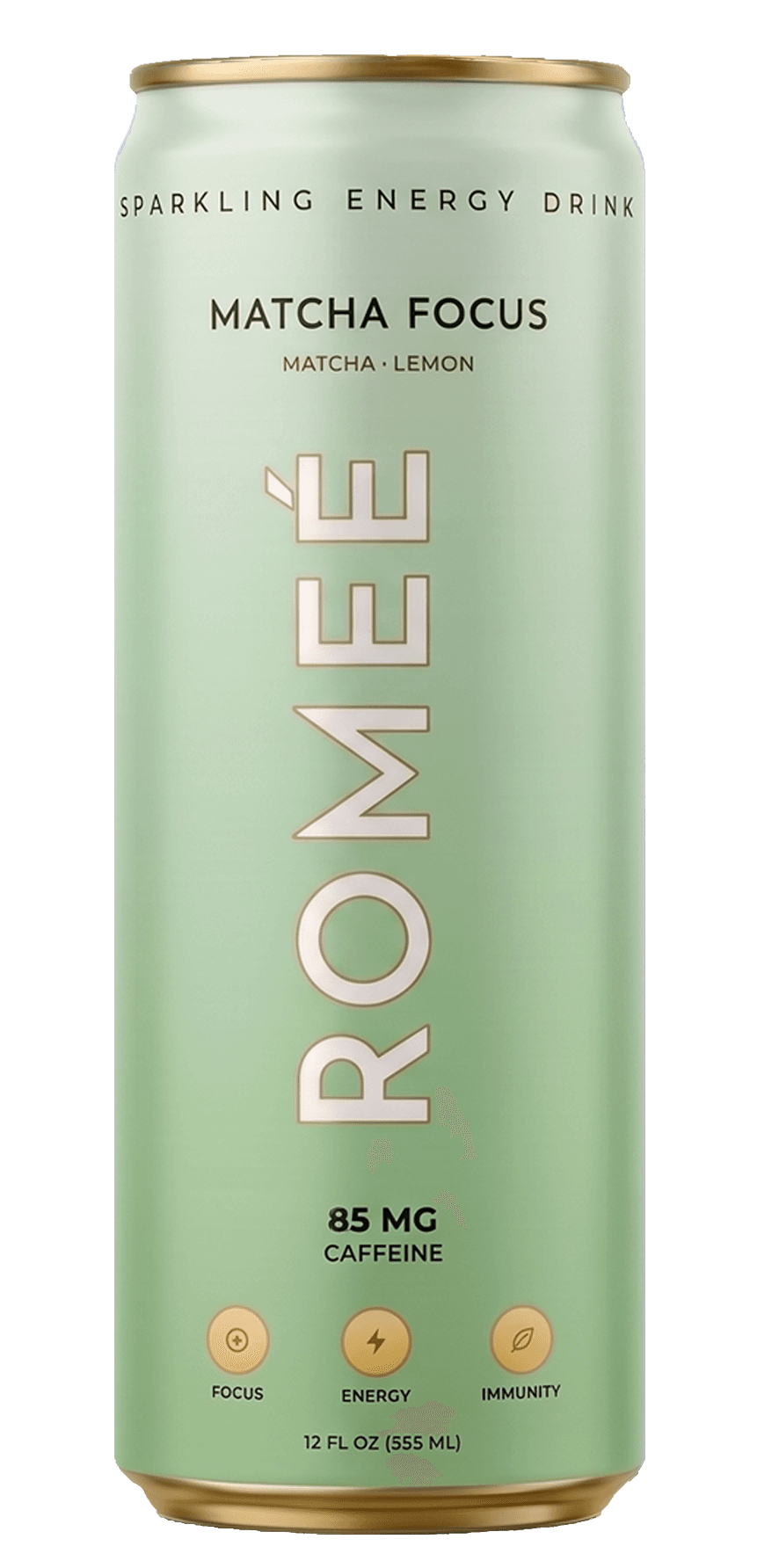
| Romeé Matcha Focus, 12 oz can | 85 mg | Our label |
Espresso is the odd one out: 80 mg in a 60 ml shot, according to EFSA.[3] Like matcha, it’s a small serving with a concentrated dose.
Why matcha differs from other green tea
Two reasons. First, the tea plants are shaded while they grow, which increases the leaf’s theanine, caffeine, chlorophyll and catechins.[2] Second, matcha is the whole leaf, ground to a fine powder. With steeped tea you drink an infusion and throw the leaves away. With matcha you drink the leaf.
Is matcha energy calmer?
That’s the popular claim, and it usually points to L-theanine, which matcha contains in meaningful amounts. The controlled research is on caffeine and L-theanine taken together in measured doses, and it found moderate, short-term improvements in attention and alertness.[4] We haven’t found strong head-to-head trials comparing how matcha and coffee feel.
Which should you choose?
Choose by the number you want. If you want more caffeine, a 12-ounce coffee usually delivers more. If you want less, or you prefer tea, matcha lets you set the dose by the gram. Either way, the milligrams matter most.
Where Matcha Focus fits
Matcha Focus has 85 mg of caffeine from organic green tea, plus organic matcha and L-theanine, in a sparkling 12-ounce can with 30 calories. That’s below the low end of the FDA’s range for a 12-ounce coffee, and the number is printed on the can, so you’re not estimating by the spoonful.
Like every Romeé flavor, it’s sweetened with organic agave syrup and organic monk fruit extract, with 4 g of added sugar.
From Romeé
Matcha Focus: 85 mg of caffeine from organic green tea, with organic matcha and L-theanine.
Pre-order now. Orders ship once our first production run is in hand, ahead of our Fall 2026 launch.
Frequently asked questions
Does matcha have more caffeine than coffee?
Per gram, yes: published analyses put matcha at 18.9 to 44.4 mg of caffeine per gram, versus about 10 to 12 mg for coffee beans. Per cup, coffee usually has more, because a 12-ounce coffee (113 to 247 mg, per the FDA) is brewed from many more grams of beans than a serving of matcha uses.
How much caffeine is in a cup of matcha?
It depends on how much powder you use and the grade. At the published range of 18.9 to 44.4 mg per gram, 1 gram gives about 19 to 44 mg of caffeine and 2 grams about 38 to 89 mg.
Is matcha the same as green tea?
Matcha is a type of green tea made from shade-grown leaves ground into a fine powder. With regular green tea you steep the leaves and discard them. With matcha you drink the whole leaf.
Is matcha better for you than coffee?
They’re different drinks. Matcha brings L-theanine, and coffee usually brings more caffeine per cup, so the better pick depends on the caffeine dose you want.
How much caffeine is in Romeé Matcha Focus?
85 mg per 12-ounce can, from organic green tea. It also contains organic matcha and L-theanine, and has 30 calories.
Sources
- 1.Spilling the Beans: How Much Caffeine is Too Much?. U.S. Food and Drug Administration. Consumer Update, content current as of 08/28/2024. Regulator
- 2.Kochman J, Jakubczyk K, Antoniewicz J, Mruk H, Janda K. Health Benefits and Chemical Composition of Matcha Green Tea: A Review. Molecules. 2020;26(1):85. Review
- 3.EFSA Panel on Dietetic Products, Nutrition and Allergies. Scientific Opinion on the safety of caffeine. EFSA Journal. 2015;13(5):4102. Regulator
- 4.Camfield DA, Stough C, Farrimond J, Scholey AB. Acute effects of tea constituents L-theanine, caffeine, and epigallocatechin gallate on cognitive function and mood: a systematic review and meta-analysis. Nutrition Reviews. 2014;72(8):507-522. Review
This article is for general education. It is not medical advice. If you are pregnant, nursing, under 18, sensitive to caffeine, or managing a health condition, talk to your doctor.